- Crypto Pragmatist by M6 Labs
- Posts
- Markets Lean Risk-On, Crypto Still Searching for Direction
Markets Lean Risk-On, Crypto Still Searching for Direction
Hard Assets Lead, Institutions Accumulate, Structure Slowly Rebuilds

The Coiners
January 10, 2026
GM Anon!
Markets are sending mixed but increasingly interesting signals. Equities and hard assets continue to attract capital as liquidity expectations improve, yet crypto remains stuck in a positioning phase rather than a full-blown risk-on regime.
BTC showed strength earlier in the week but failed to push through, leaving price trapped in range while flows and institutional activity quietly build beneath the surface. With macro tailwinds improving and structural adoption accelerating, the gap between improving fundamentals and cautious price action is widening — and that tension will define the next phase of the market. Let’s dive in!
TLDR
US equities stayed bid; mega-cap tech leadership supported risk.
Gold and silver surged, reinforcing a “risk-on but hedged” backdrop.
Macro tone leaned liquidity-positive with Fed leadership chatter and 2026 cut talk; BoJ outlook improving.
Crypto lagged: BTC failed to push through; ETH, SOL, BNB stayed heavy with ETF outflow pressure.
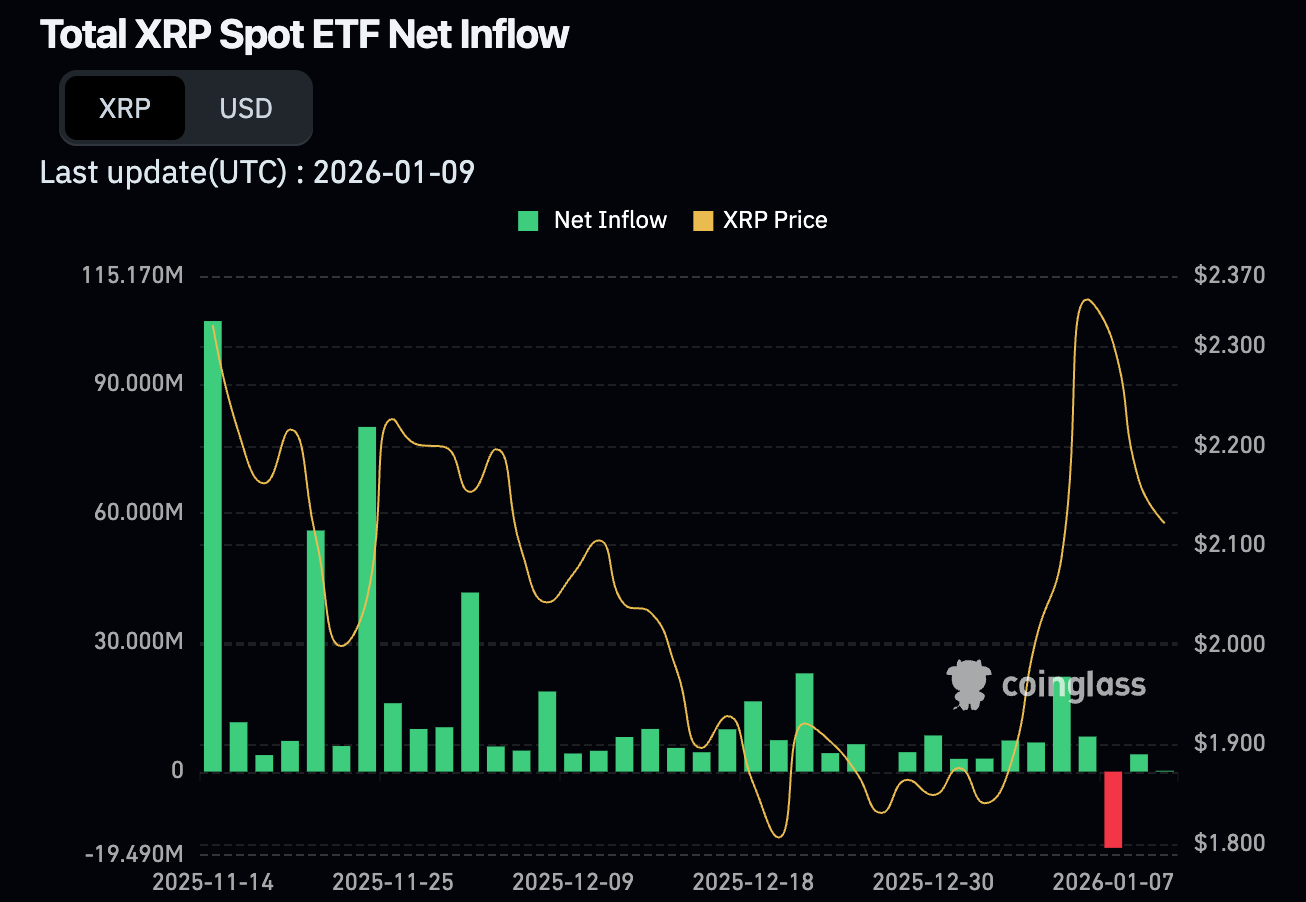
XRP weakened alongside its first net ETF outflows; alts broadly continued to bleed.
Institutional/treasury demand stayed active: large BTC adds, big ETH buying and staking, Florida eyeing a BTC reserve.
Morgan Stanley advanced ETF filings and plans for trading/wallets; JP Morgan signaled de-risking is fading and JPM Coin is coming.
DATs not being excluded from MSCI reduced a potential forced-selling overhang.
Infrastructure kept building: Polymarket expansion, JupUSD launch, Wyoming stablecoin on Solana, tokenized stocks over $1B AUM.
Breadth remains weak: a few standout winners, but most coins still below key moving averages
🚀 The 2026 meta is: perp DEXes.
They’ve produced some of the biggest airdrops this cycle because they generate real volume and real fees. Early, active, and consistent Hyperliquid users saw $5K–$50K, while those with serious capital to farm received 6–7 figures. Lighter followed the same pattern. The edge was being strategic and consistent over time.
Once these platforms get crowded, points get harder and rewards get diluted. That always happens.
Variational is still early. It’s one of the newest major perp DEXes without a token, and its points program only launched in December. Despite that, it already ranks #5 by 30-day perp volume and #4 by open interest — which tells you real capital is already there while participation is still relatively small. It’s backed by Coinbase Ventures, Dragonfly, Bain Capital Crypto, Hack VC, and others. Major bonus: the platform runs zero trading fees, which makes it easier to generate meaningful volume and accrue points efficiently.
The best part is you can play this without directional risk by staying neutral. For example: open a BTC long on Variational and a matching short on another perp DEX. Price moves cancel out, but the volume counts.
This is how early users have historically captured the bulk of perp DEX airdrops.
There are no guarantees. But if you’re going to farm smart, this is the phase where the math has worked in the past.
⚠️ Codes are limited and required to authenticate your account, so don’t waste a spot if you’re not dead serious about farming. Ours will get you Bronze tier + a 12% points boost:
Stay tuned — we’ll be sharing further updates, opportunities, and a playbook for how to optimize your perp DEX farming strategies.
The Coiners
Market Update
Global markets continued to trade with a firm bid this week, with US equities pushing higher as the S&P 500 closed just under 7,000 and the Dow Jones climbed above 49,500. Strong productivity data and renewed confidence in large-cap technology, highlighted by Alphabet overtaking Apple by market value, helped keep risk appetite elevated.
That optimism was mirrored in hard assets, with gold settling at $4,510 and silver surging nearly 4% toward $80, signalling that capital is rotating not only into equities but also into stores of value as investors position for looser financial conditions. With the Fed approaching a chair decision, calls emerging for significant rate cuts in 2026, and the Bank of Japan preparing to lift its growth outlook on stimulus, the macro backdrop remains tilted toward liquidity and forward growth, even as bearishness toward oil hits a decade high and highlights a shift away from late-cycle trades.

Crypto markets have struggled to keep pace with that broader risk-on tone. BTC, ETH, SOL and BNB all remained under pressure as ETF flows stayed negative and traders continued to de-risk, leaving price action heavy despite improving macro conditions. XRP fell 10% alongside its first net ETF outflows, and the wider altcoin complex continued to slide, reinforcing the sense that positioning in crypto remains defensive even as other asset classes show renewed confidence.
Beneath the surface, however, institutional and treasury activity tells a very different story. Strategy added $116M of BTC over the past week, BitMine accumulated 33K ETH, and Sharplink deployed $170M of ETH into Linea staking, while Florida announced plans to hold BTC as part of a state reserve.
Morgan Stanley filed for BTC and SOL ETFs and is preparing to allow crypto trading and wallets, and JP Morgan said crypto de-risking is likely over as it prepares to roll out JPM Coin on the Canton network. Even with miners such as Riot selling BTC to manage weaker economics, the balance of large-scale capital flows continues to lean toward accumulation rather than exit. In parallel, risk framing around benchmark access remained in focus after headlines that DATs will not be excluded from MSCI for the time being, easing an overhang that could have amplified forced selling pressure.

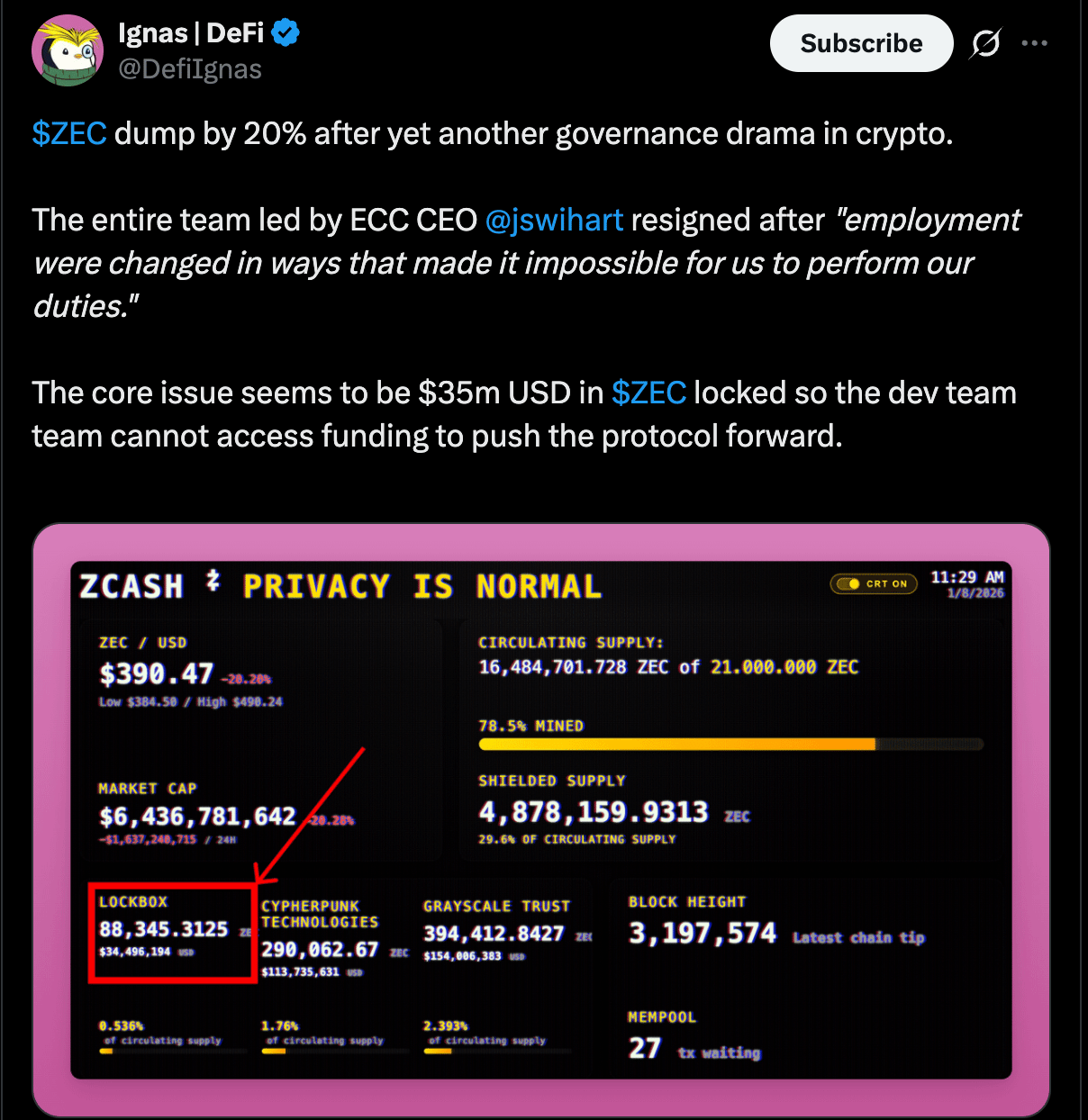
Within the ecosystem, capital is increasingly flowing toward infrastructure and real-world integration. Polymarket expanded into real estate and signed an exclusive deal with Dow Jones, Jupiter launched its JupUSD stablecoin with Ethena, and Wyoming issued a state-backed stablecoin on Solana, pointing to the steady institutionalization of on-chain finance. Tokenized stocks surpassed $1B in assets under management, Fireblocks agreed to acquire crypto accounting firm TRES, and Optimism proposed buybacks for OP, even as pockets of fragility remained visible through a major exploit that wiped TRU and renewed volatility around ZEC following developer departures.
Regulatory and corporate developments remain the key swing factor for sentiment. A major crypto bill is moving toward critical Senate votes later this month, South Korea confirmed plans to allow crypto ETFs, and FINRA added crypto policy figures to its board, while firms across finance and tech continue to lean in. Binance launched traditional-finance perpetuals, WLFI sought a bank charter to bring its USD1 stablecoin onshore, and Rumble rolled out a crypto wallet. The net result is a market where macro and institutional tailwinds are strengthening even as near-term flow pressure keeps crypto prices constrained, setting up a growing tension between improving fundamentals and cautious positioning.
Market Data Points
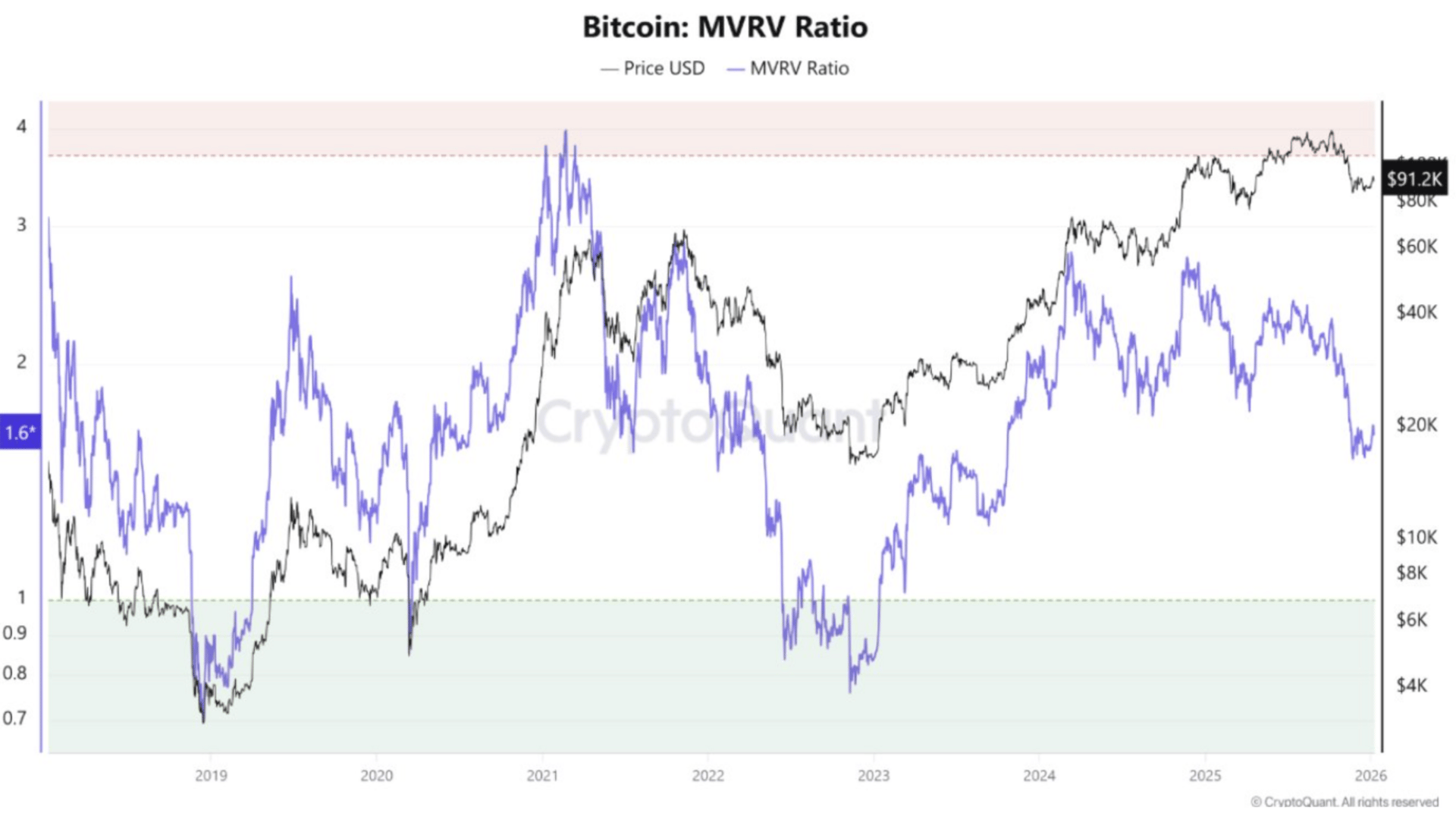
MVRV has cooled from earlier stretch levels, consistent with valuation resetting rather than trend failure. This is the kind of compression you typically see when the market digests prior gains and burns off excess optimism. As long as price holds structure, a softer MVRV profile tends to be more constructive than bearish because it reduces froth without requiring a deeper capitulation.
SOPR is hovering near 1, meaning realized selling is occurring close to aggregate cost basis rather than at strong profit. That usually signals profit taking has been largely absorbed and marginal sellers are losing urgency. In practice, SOPR around breakeven often marks a transition phase where the market is more sensitive to flows, but less prone to relentless distribution.

The BTC to stablecoin reserve ratio on Binance has been rising, indicating that stablecoin balances are being deployed into BTC rather than sitting idle. This matters because Binance tends to reflect more active trading capital than passive custody flows. When this ratio rises during a consolidation, it often points to early stage accumulation rather than speculative excess.

The ETH validator queue remains elevated, meaning more ETH is waiting to enter staking than exit. That dynamic implies continued confidence in Ethereum’s yield and security model even during periods of market chop.

Majors & Memes
Majors finished the week with a mixed, slightly defensive tone, and the overall market still felt more like consolidation than a clean trend. BTC showed promising strength earlier in the week, but it ultimately couldn’t break through and sustain the move, leaving it stuck in a familiar range rather than kicking off a broader risk-on leg. ETH lagged relative to the pack, while BNB and SOL held up better and managed to stay constructive on the week. XRP and TRX were among the steadier large-cap performers, while DOGE remained softer, reinforcing that leadership is still narrow and selective rather than broad-based.
The most notable upside was concentrated in a handful of higher-beta names that clearly captured rotation and momentum. XCN was the standout leader, while RENDER and POL also put in strong weekly moves alongside a cluster of other winners including JASMY, STX, VIRTUAL, and GLM.
On the laggard side, weakness was more widespread and, in several cases, sharp. NIGHT, ZEC, and RIVER were among the heaviest losers, while other names like UNI, QNT, FIL, ONDO, TON, and DOT also bled lower. When even recognizable, liquid tokens can’t hold bids and keep trending down, it usually speaks to a market that’s still prioritizing capital preservation and short-term trading over building durable positions.
The broader read-through is that, despite isolated breakouts, most coins remain below key moving averages and the altcoin market still has a long way to go before it looks like a true recovery. With BTC unable to convert early-week strength into a decisive breakout, the default posture stays cautious: rotation is happening, but it’s happening inside a market that still lacks breadth and sustained follow-through.

Smart Money Moves
Smart money flows this week still look selective and quiet, with no broad resurgence in speculative risk, but a clear cluster of small-cap accumulation. DREAMS leads the board on seven-day inflows and also remains positive on the 30-day window, with CULT, URANUS, and PAYAI showing a similar profile. The main signal is the persistence of net buying across the 7-day and 30-day columns, even when 24-hour activity is muted, which suggests positions are being built gradually rather than expressed through short, reactive bursts.
The distribution of buyers adds another layer. Several of the leading inflow names are driven by a very small number of smart-money wallets, while a second tier shows broader engagement across more traders. GF, LLDAP, PAPAPARSE, MONOLOG, and ALAMOFIRE fall into that more distributed bucket, and LLDAP stands out for stronger longer-term accumulation relative to its weekly flow.
Taken together, the picture remains consistent with a cautious tape: the market isn’t seeing wide risk appetite, but capital is still rotating into a narrow list of targets where conviction appears higher. With weekly inflows supported by positive 30-day flows, the data reads more like ongoing accumulation than a late-stage momentum trade.

That wraps up this post—we hope you found the insights valuable. See you next week, anon! 🚀
Reply